Chapter Four: Modeling decisions
Companies, facilities and commodities: choosing between alternatives
Schema so far
If you are starting here, run these two queries in an empty database.
#!test[schema]
define

attribute name, value string;

attribute country_name, sub name;
attribute province_name, sub name;
attribute kabupaten_name, sub name;

entity place @abstract;

entity country,
  sub place,
  owns country_name @key;

entity province,
  sub place,
  owns province_name @key;

entity kabupaten,
  sub place,
  owns kabupaten_name @key;
#!test[schema]
define
relation containment,
relates parent @card(1),
relates child @card(1);
entity country,
plays containment:parent;
entity province,
plays containment:child @card(0..1), # at most one parent
plays containment:parent;
entity kabupaten,
plays containment:child @card(0..1); # at most one parentHarder columns
The next six columns are harder. Here are a few rows:
| mill | mill_group | refinery | refinery_group | exporter | exporter_group |
|---|---|---|---|---|---|
PUCUK JAYA |
CHELLAM PLANTATIONS |
NOT REFINED |
NOT REFINED |
SUMBER HIJAU UTAMA |
ROYAL GOLDEN EAGLE |
TAPIAN NADENGGAN (JAK LUAY) |
SINAR MAS |
SMART TBK (TARJUN REFINERY & KERNEL CRUSHING PLANT) |
SINAR MAS |
SINAR MAS AGRO RESOURCES AND TECHNOLOGY |
SINAR MAS |
DWIWIRA LESTARI JAYA |
TRIPUTRA AGRO PERSADA |
LDC EAST INDONESIA |
LOUIS DREYFUS |
LDC EAST INDONESIA |
LOUIS DREYFUS |
The same names turn up in different columns: SINAR MAS is a mill group, a refinery group and an exporter group, and LDC EAST INDONESIA is both a refinery and an exporter.
Are a mill and a mill group different kinds of thing?
Is an exporter a kind of thing at all?
Option 1: one type per column
Taking the header literally gives six entity types.
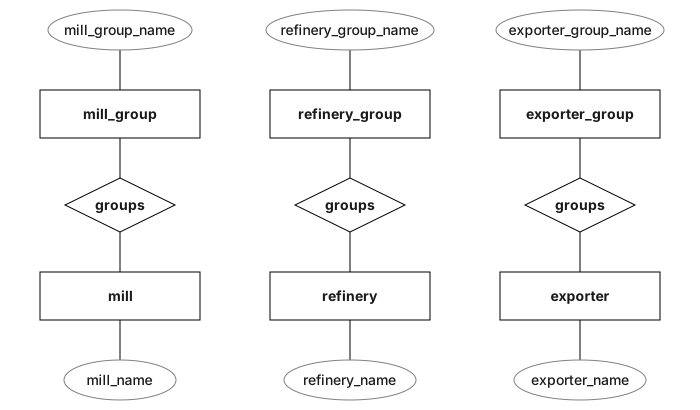
define

entity mill;
entity mill_group;
entity refinery;
entity refinery_group;
entity exporter;
entity exporter_group;
This model is easy to load, but it records the same company several times, once per column it appears in, with nothing connecting the copies. It also treats being an exporter as a kind of thing, when it is something a company does. Don’t run it; the rest of the course uses option 2.
Option 2: companies and facilities
The dataset’s documentation says that each *_group column "groups the [corresponding] column into parent companies where applicable".
So the data describes only two kinds of thing, linked by ownership:
-
Facilities, which are mills or refineries, each owned by at most one company.
-
Companies, which own facilities and other companies.
Exporter and importer are not kinds of company. They are roles a company plays in a trade flow, and the same company can play either, or both, in different flows. In UFO’s terms, a company is a kind, and exporter is a role: anti-rigid, because a company can stop exporting without ceasing to be a company. TypeDB types are rigid, so roles of this kind are modeled as roles in relations, not as subtypes.
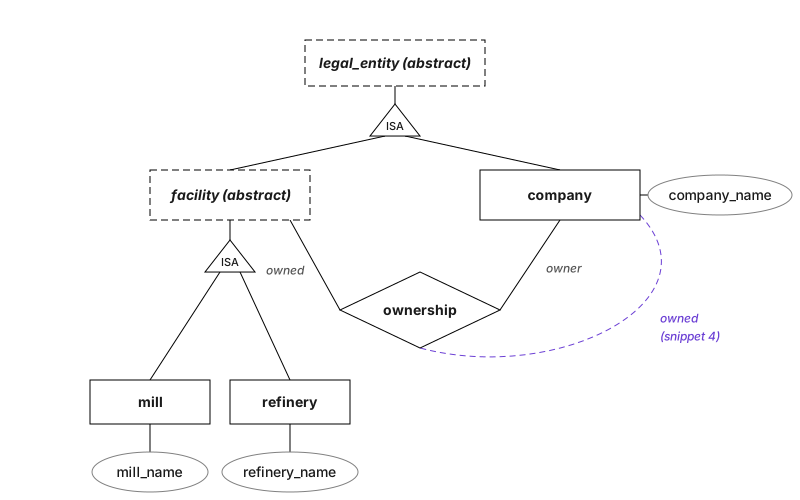
Dashed boxes are abstract types.
legal_entity generalizes companies and facilities, and facility generalizes mills and refineries.
The dashed line is added in the next section.
#!test[schema]
define

attribute facility_name, sub name;
attribute mill_name, sub facility_name;
attribute refinery_name, sub facility_name;
attribute company_name, sub name;

entity legal_entity @abstract;

entity facility @abstract,
  sub legal_entity,
  plays ownership:owned @card(0..1);   # at most one owner
entity mill,
  sub facility,
  owns mill_name;
entity refinery,
  sub facility,
  owns refinery_name;

entity company,
  sub legal_entity,
  owns company_name @key,
  plays ownership:owner;

relation ownership,
  relates owner @card(1),
relates owned @card(1);-
A two-level hierarchy:
millandrefineryare kinds offacility, and facilities and companies are kinds oflegal_entity. -
facility plays ownership:owned: a role played by a supertype is inherited, so mills and refineries can both be owned. -
Companies are identified by name. Mills and refineries own a name but have no key: Trase identifies facilities by its own IDs, which this excerpt drops, and facility names are not guaranteed to be unique.
|
Subtype, role or attribute?
This choice comes up in most models. Three questions help:
|
Companies owning companies
In some rows, LDC EAST INDONESIA is both the refinery and the exporter, and LOUIS DREYFUS is the group of both.
We interpret this as: the company LDC East Indonesia owns the refinery of the same name and handles its exports, and Louis Dreyfus is its parent company.
So companies, too, can be owned:
#!test[schema]
define

entity company,
  plays ownership:owned @card(0..1);   # a company has at most one parent company
Ownership now forms a hierarchy of any depth: a parent company owns a company, which owns a refinery. Chapter Seven queries it to any depth with a recursive function.
Commodities
The data has two commodities: PALM OIL and REFINED PALM OIL.
There are three reasonable ways to model them:
| Option | Model | Trade-off |
|---|---|---|
a |
One entity type |
Simplest. Adding a commodity means changing the value set. |
b |
Two independent entity types, |
Every role a commodity plays must be declared twice, and queries over all commodities must name both types. |
c |
An abstract |
Queries over all commodities stay simple. Useful when the subtypes own or play different things. |
Option a is enough for now:
#!test[schema]
define

attribute commodity_name,
  sub name,
  value string @values("PALM OIL", "REFINED PALM OIL");

entity commodity,
  owns commodity_name @key;
@values restricts an attribute type to a fixed set of values, like an enumeration.
Combined with @key, it also means there can be at most two commodities: each needs a distinct name, and only two names exist.
Challenge
Implement option c with the same guarantee: at most one instance of each commodity subtype.
Answer
Put the value restriction on each subtype’s ownership, rather than on the attribute type. Run this only in a separate, empty database with the places schema, since it conflicts with option a:
define

attribute commodity_name, sub name;

entity commodity @abstract;

entity palm_oil,
  sub commodity,
  owns commodity_name @key @values("PALM OIL");

entity refined_palm_oil,
  sub commodity,
  owns commodity_name @key @values("REFINED PALM OIL");
Each subtype can now only own its own name, and the key makes that name unique, so each subtype has at most one instance.